Designing for Confidence,
Not Completion
Parleva is an AI language practice product for web and Android. As an independent product designer, I took it from problem framing through launch — helping adult learners move past passive study and start having real conversations in a low-pressure environment.
6,000+Across Google Play and web since January 2026
80%Of registered users started a conversation
34sMedian time to first conversation
#20Google Play Top New Free Education Apps
Independent product design — from problem to launch
- 6,000+ downloads · #20 Google Play Top New Free Education Apps
- 80% activation — registered users who started a conversation
- 34-second median time to first conversation
- 90% of early app reviews were 5-star
Product strategy · conversation UX · adaptive AI behavior design · coaching systems · front-end implementation · Firebase architecture · analytics · launch
Behavioral rules · failure states · guardrails · adaptive logic · feedback loops · motivation systems that prioritize psychological safety over gamification
Fast starts turned into real, sustained practice
Beyond the activation numbers above, the behavior data showed the core experience working: users stayed in conversation long enough to build momentum, then came back for more.
Depth showed users staying in realistic practice well past a quick sample — long enough to recover, continue, and build momentum.
Users came back without streak pressure, suggesting the core loop created value beyond a single interaction.
Adult learners had the content. They lacked the confidence to use it.
Many language apps help users study vocabulary or complete lessons, but adult learners still hesitate when it is time to speak. What's missing is confidence, immediacy, and low-pressure practice.
Can I say something to a real person without freezing?
Traditional apps treat conversation as something learners unlock after enough preparation. Parleva starts from a different premise:
If the goal is speaking, conversation should be the method — not the reward at the end of learning.
- Lessons
- Quizzes
- Streaks
- Delayed speaking
- Completion
- Progress as points
- Scenarios
- Realistic conversation
- Calm consistency
- Immediate speaking
- Confidence
- Progress as capability
Confidence is built through exposure, not completion
Speaking confidence is experiential. It comes from staying in a conversation long enough to stumble, recover, and realize you can handle it.
That meant the product had to feel like a safe practice space — not a lesson with a chat feature attached. The exposure itself is the mechanism.
The brand promise shaped product decisions directly
The brand promise — Practice real conversations. Build real confidence. — worked as a design constraint. Every product decision was measured against it.
- "Complete your lesson"
- "Keep your streak"
- "You missed 3 days"
- "Don't fall behind"
- "Start a conversation"
- "Keep going"
- "You're getting more comfortable"
- "Try saying it this way"
Three product questions shaped the architecture
How do we get users into conversation before anxiety or friction builds?
How do we keep conversations realistic without overwhelming learners?
How do we motivate repeat practice without streak pressure or gamified guilt?
Three systems working together
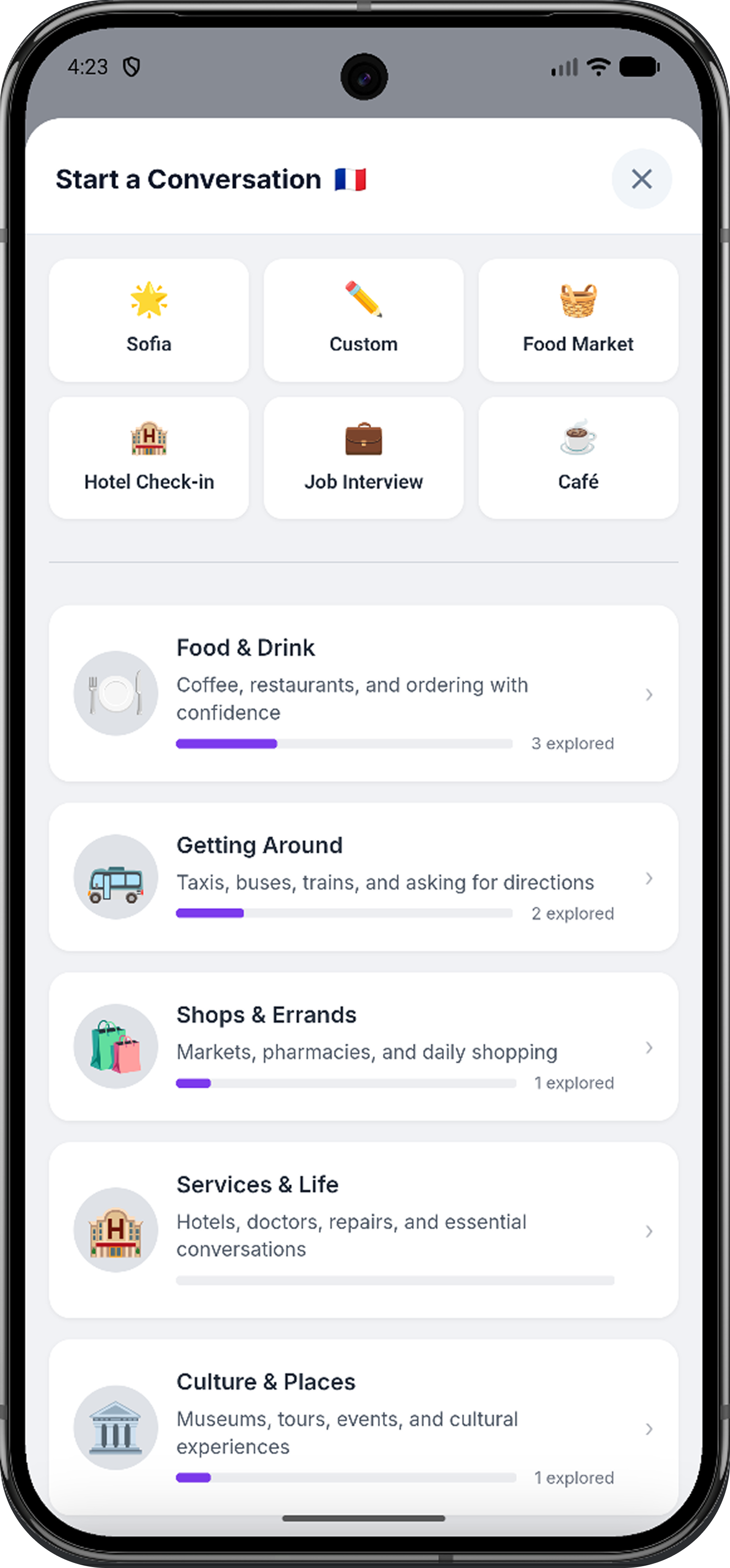
Parleva is a conversation-first practice product, not a language course with a conversation mode bolted on. A learner chooses a scenario and starts talking. The AI plays the role, adapts to the learner's ability, and provides focused coaching — no placement test, no XP, no lesson map required.
1 — Conversation Engine
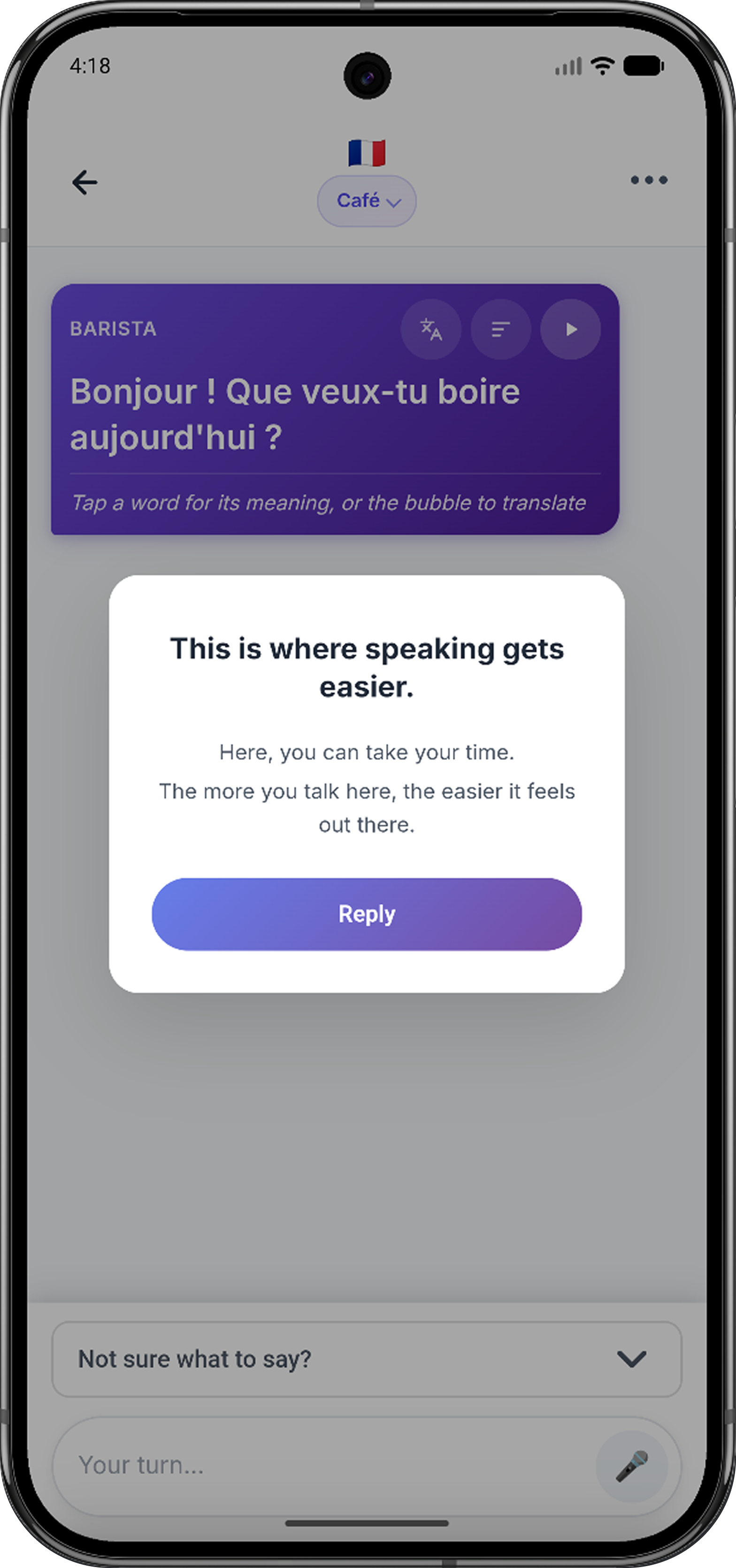
The assistant needed to behave like a supportive tutor — keeping conversation moving, adapting to the learner's level, correcting without overwhelming, and never turning practice into a test.
Most tools close the scene once the task resolves. Parleva doesn't. Each scenario is designed with hooks that create realistic follow-ups and opportunities to recover.
| Step | Purpose |
|---|---|
| User message | Gets the learner actively producing language |
| AI responds in role | Preserves realism and scenario immersion |
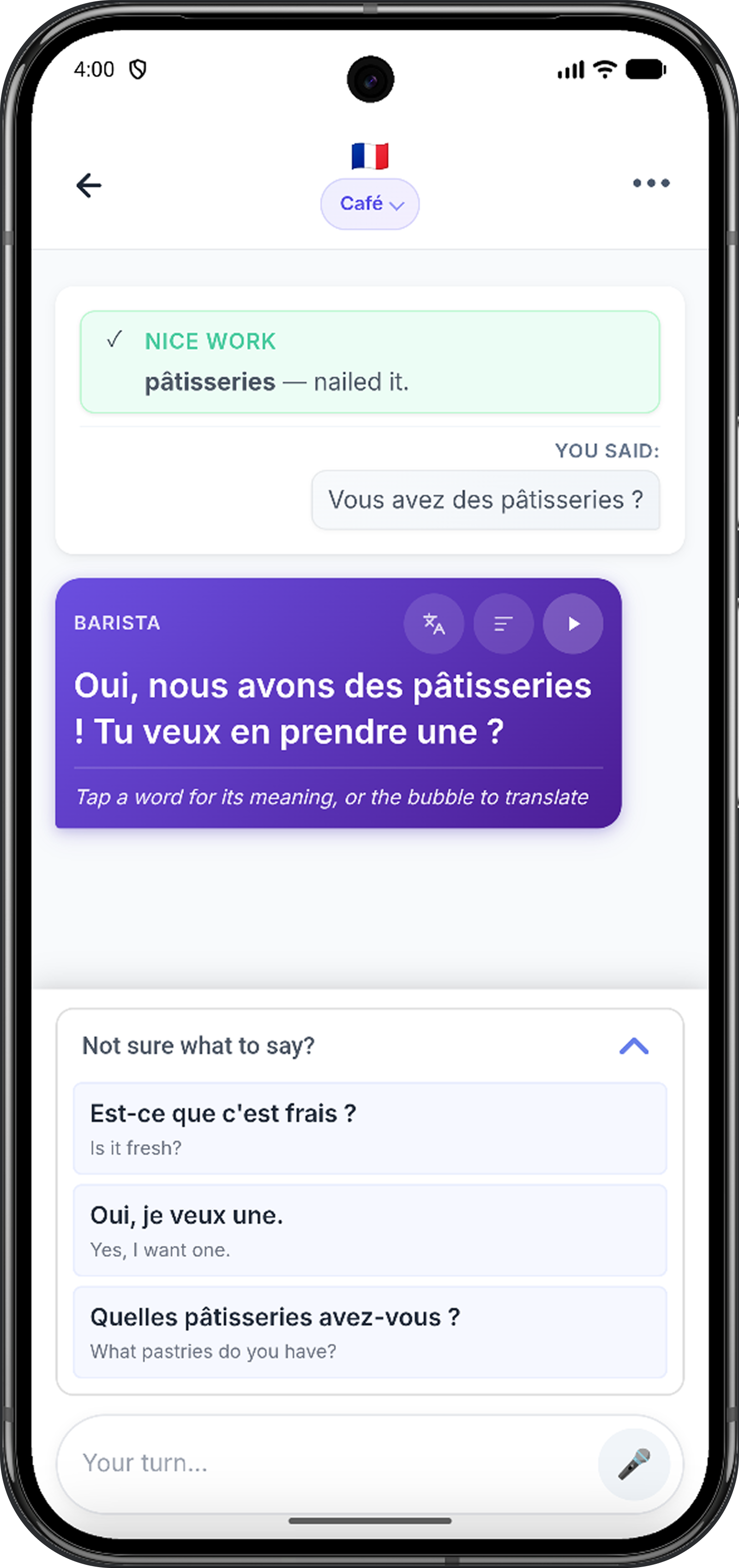
| One coaching signal | Helps without overwhelming |
| Suggested replies | Prevents the blank-page moment |
| Next turn | Keeps the learner in conversation |
2 — Adaptive Intelligence
No placement test. Placement tests create friction before value and can reinforce the anxiety the product is designed to reduce. Instead, Parleva calibrates through use — generating a live signal from message length, correctness, and language choice. The learner starts talking. The product meets them where they are.
Calibration happens through use, not a placement test.
3 — Motivation Model
Speaking requires vulnerability — sounding imperfect, pausing, getting things wrong, trying again. No XP, streaks, leaderboards, or guilt notifications. The product's job is to protect that psychological safety, not add pressure on top of it.
- XP
- Streaks
- Loss aversion
- Leaderboards
- Pressure to return
- Real-world practice
- Calm consistency
- Intrinsic confidence
- Personal capability
- Reason to return
Parleva does not ask: How do we make users feel bad for leaving?
It asks: How do we make each conversation feel worth coming back to?
How the three systems connect
Each system shapes the others. The Conversation Engine produces the turns that feed the Adaptive Intelligence. The Adaptive Intelligence determines what the Conversation Engine says next. The Motivation Model governs both — no mechanic is introduced unless it supports the learner's return rather than pressures it.
Designing the rules that made the AI feel designed
The AI in Parleva is not a general chatbot with a tutor persona added on top. Every behavior — what it says, when it corrects, how it responds to struggle, what it is constrained not to do — was a deliberate design decision. Getting the conversation to feel natural required defining the AI's constraints as precisely as its capabilities.
Conversation rules
These behavioral constraints kept every AI response tutor-like rather than chatbot-like. Each rule emerged through iteration — testing what happened when responses broke character, overcorrected, or ended scenes too early.
| Rule | Design rationale |
|---|---|
| Stay in character throughout the scenario | Breaking role reintroduces the classroom dynamic the product was designed to avoid |
| Coaching appears after the in-role response, never before | The learner hears a real reply first. Coaching is a signal, not an interruption. |
| One correction per turn maximum | More than one overwhelms. The goal is conversation, not error auditing. |
| Always advance — never dead-end a turn | Conversations that stall destroy momentum and confidence. |
| Extend past task completion | Real fluency practice happens beyond the obvious end point. Scenarios include hooks that keep the conversation going. |
| Calibration is invisible to the user | Labeling difficulty reintroduces the anxiety of being assessed. |
Failure states and guardrails
Designing for failure was as important as designing the happy path. The most critical moments are when the learner hesitates, struggles, or steps outside the scenario — exactly when the product's response either builds or breaks trust.
| State | AI behavior | Why |
|---|---|---|
| User sends 1–2 words | Responds briefly, re-invites with an open question | A long AI turn would further intimidate. Gentle re-invitation is the right response. |
| User switches to English | Acknowledges warmly, redirects to target language without penalty | Punishing it creates shame, not confidence. |
| User input is off-scenario | Bridges back naturally without correcting the detour | Real conversations drift. Rigid adherence breaks realism. |
| Conversation stalls | Introduces a new hook or follow-up question | Dead silence after a stall is abandonment. |
| Same error repeated across turns | Flags it once, does not repeat the correction | Once is coaching. Twice is pressure. |
Product judgment calls
The hardest decisions were product calls, not technical ones — about what the AI should and should not do, and why.
No difficulty label, even though calibration is happening in real time
Suggested replies generated fresh each turn, calibrated to current difficulty — not static options
Only the user can end the session — the AI cannot close the conversation
Designing AI-assisted systems with defined behavioral rules, adaptive logic, feedback loops, failure handling, and measurable product outcomes — the same thinking that applies to enterprise AI, internal platforms, and complex service products.
Three decisions that shaped the experience
Minimal interface
The conversation is the interface. Feedback and support appear only when useful — not as a permanent dashboard competing for attention.
Feedback as a learning loop, not a grading system
One correction, a short explanation, and useful encouragement per turn — designed to continue the conversation, not grade the output.
Suggestions as confidence scaffolding
Suggested replies at safe, natural, and stretch levels prevent the blank-page moment where anxiety takes over — without removing the option to respond freely.
Four design bets worth naming
No gamification vs. retention pressure
Parleva gives up proven engagement mechanics like streaks and XP because guilt-driven return behavior conflicts with the product's purpose. The core conversation loop has to stand on its own.
Invisible intelligence vs. perceived simplicity
Adaptive logic works in the background, but invisible systems can be hard for users to notice. The challenge is surfacing adaptation without turning it into scores or dashboards.
Open conversation vs. structured learning
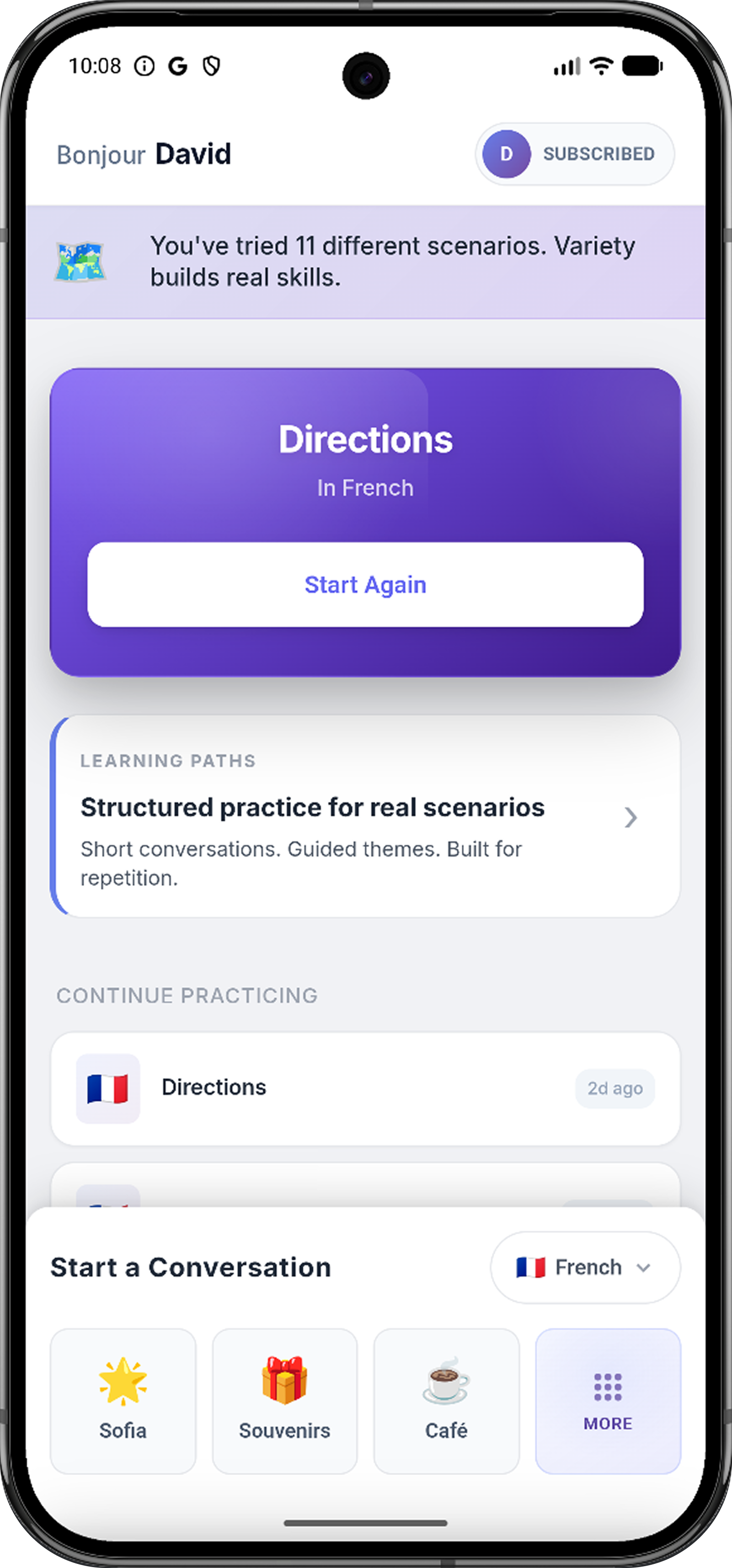
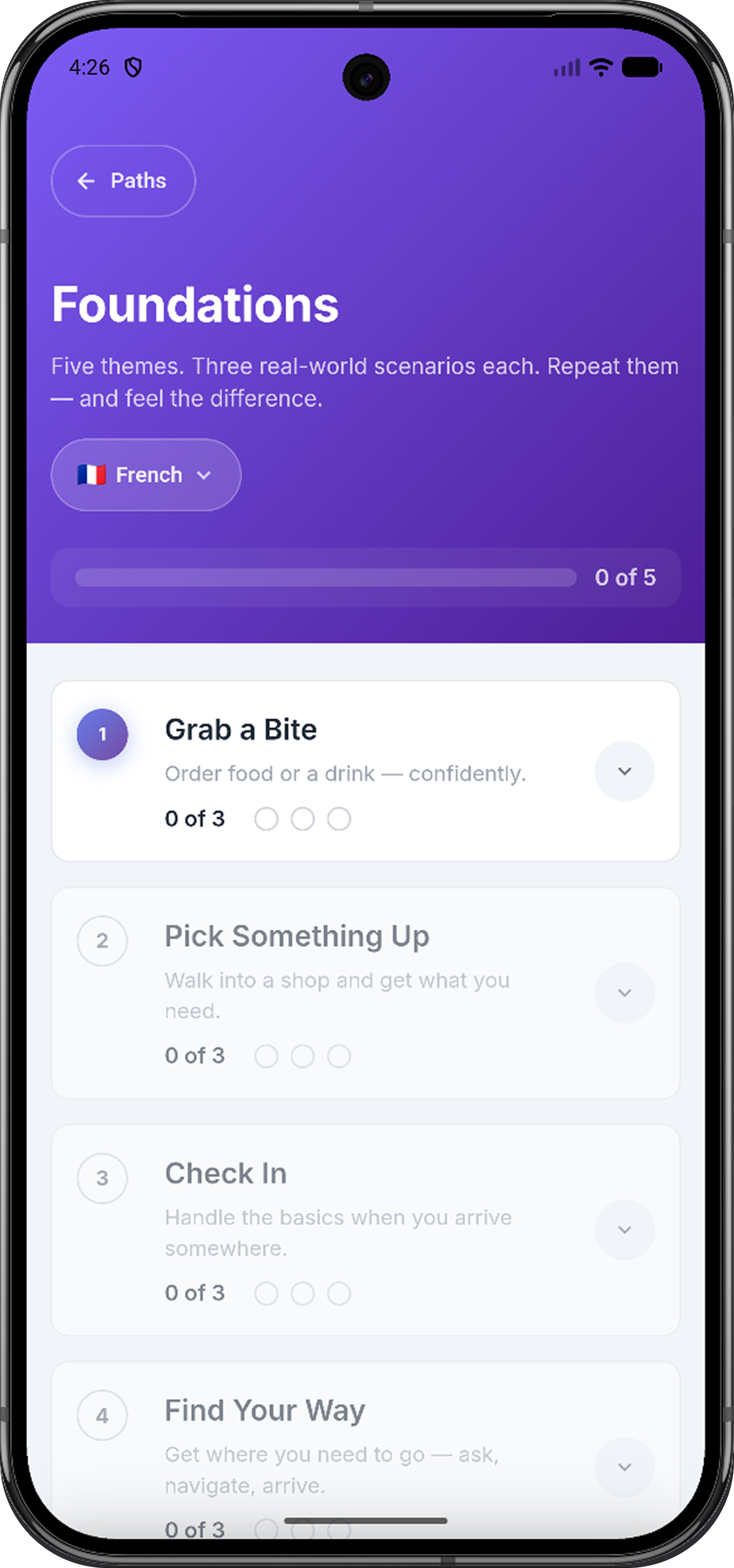
Open-ended practice gives learners freedom, but some users still want direction. Lightweight learning paths can support conversation without replacing it.
AI flexibility vs. product consistency
LLMs create natural conversation, but the product needs behavior rules for role consistency, correction boundaries, suggestions, and failure handling. The AI felt natural. The behavior stayed designed.
What the data proved
Removing placement tests and tutorial friction worked. For a product built around speaking confidence, the first exchange is the product — and the onboarding compressed the gap between curiosity and value to under a minute.
A 10-turn session is a better signal than a completed onboarding. It means the user moved past novelty and stayed in conversation long enough to stumble, recover, and keep going — which is the actual practice Parleva was designed for.
Users came back without streak pressure or guilt mechanics — which meant the core loop created genuine value. Speed got them started. Depth gave them a reason to return.
Getting users in is not the same as getting them to stay
Once users were in, the stronger product question became whether they stayed long enough for practice to become meaningful. A session that crossed 10+ turns looked less like a demo and more like the exchange Parleva was designed for.
To: How do we help more people stay long enough for the product to work?
That led to stronger scenario hooks, clearer suggestions, better conversation continuity, and earlier instrumentation around where users stalled.
Users talked about confidence, not features
The strongest signal was about identity. 90% of early app reviews were 5-star, with users consistently describing their experience in terms of confidence rather than functionality.
"It helped me to have a voice."
That was the product goal in human language: helping learners feel capable enough to speak.
"There is no better way to learn language than through real conversation."
"Ideal for learners who want real conversational practice."
Helping more users reach meaningful conversation depth
Memory and Continuity
Remember what a user practiced and where they struggled — making each return feel more personal, not more complex.
Progress That Feels Human
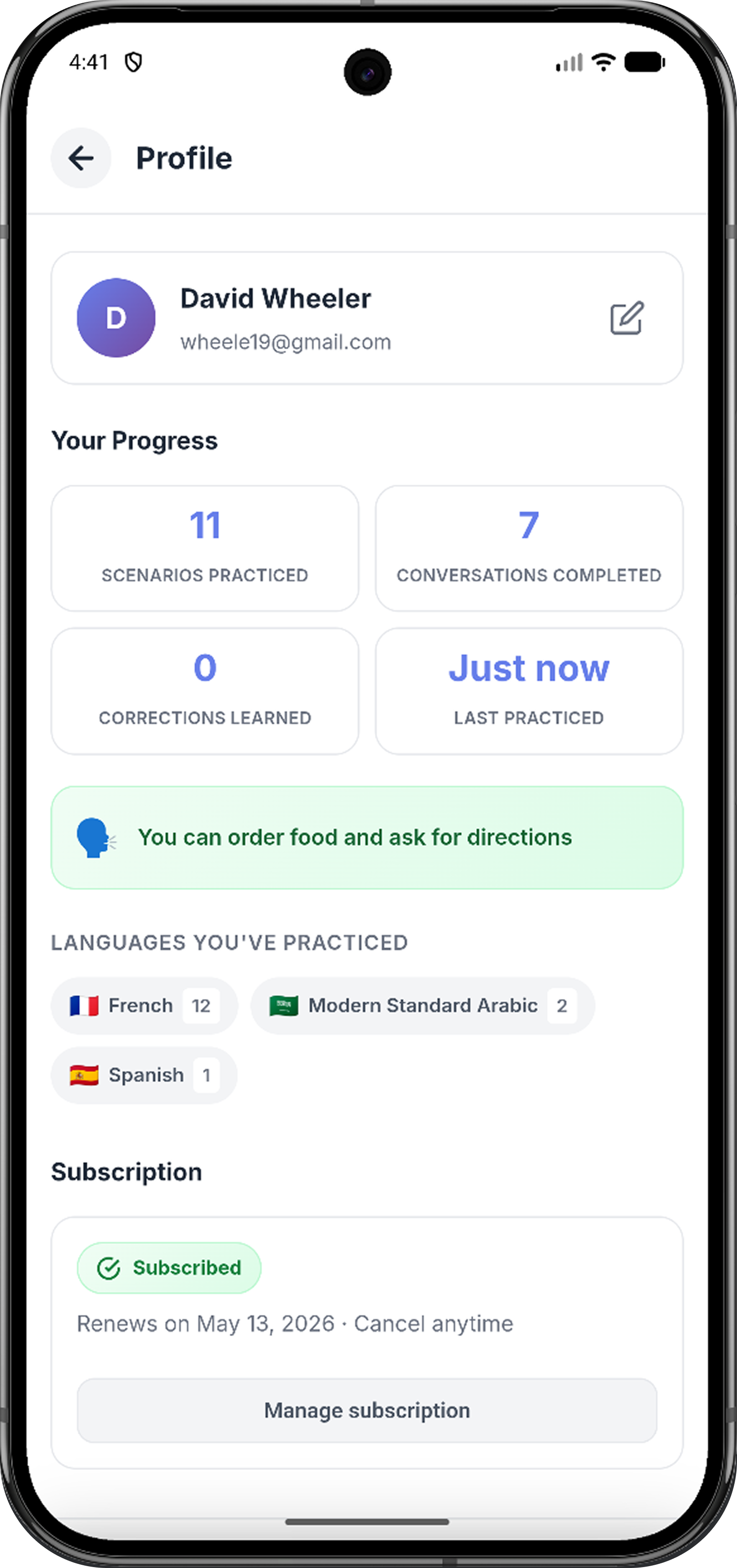
Reflect real-world capability — scenarios practiced, conversations completed, topics ready to revisit — not XP or abstract levels.
Deeper Session Insight
A calm post-session synthesis: what went well, what stretched the learner, one thing to carry forward. A reflection, not a report card.
Parleva proved that speed to value matters in AI learning products. When users can start a real conversation quickly, receive useful feedback, and feel safe making mistakes, AI becomes less of a content generator and more of a confidence-building practice partner.
That is the moment this product was built for. Every decision from here is a path back to it.